Concrete is strong and durable, but it does not last forever without wear or damage. Cracks, surface deterioration, uneven sections, and recurring problems can all be signs that your concrete needs attention.
The quick answer: Minor, localized damage can often be repaired. Replacement may be a better option when deterioration is widespread, keeps returning, or affects the stability and safe use of the concrete.
If you own a home or commercial property in Midland, TX, here are seven signs worth watching.
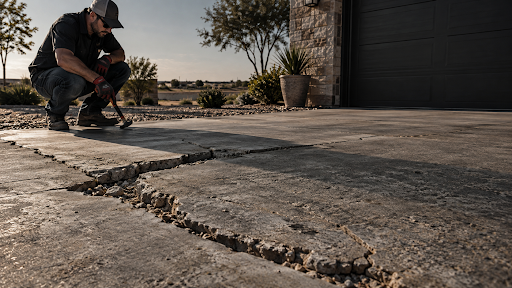
1. Cracks Are Getting Wider or Spreading
A small crack does not automatically mean the entire slab needs to be replaced. Concrete naturally responds to changes in temperature, moisture, loading, and support conditions, and different types of cracking can develop for different reasons. NRMCA notes that many early random cracks may be more cosmetic than structural, although the cause and severity still matter.
What deserves more attention is a crack that:
- continues to widen
- spreads across a larger area
- develops uneven edges
- repeatedly returns after repair
- appears alongside other movement or deterioration
A concrete professional can help determine whether a localized repair is reasonable or whether the problem extends deeper into the slab.
For additional technical information, see the NRMCA guide to cracking concrete surfaces.
2. Parts of the Concrete Are Uneven or Sinking
A driveway, walkway, patio, or slab should provide a reasonably stable surface. If one section has dropped below another, the problem may involve movement or loss of support beneath the concrete.
Uneven concrete can create drainage issues, make surfaces uncomfortable to use, and potentially create a trip hazard.
The right solution depends on what caused the movement and how much of the slab is affected. A small isolated area may have different repair options than a slab with widespread settlement.
3. The Surface Is Chipping, Flaking, or Spalling
When pieces of concrete begin breaking away from the surface or edges, the condition is commonly described as spalling.
Minor surface damage may sometimes be suitable for localized repair. More severe or widespread spalling can indicate that a larger repair is needed. FHWA guidance similarly distinguishes localized spalling that can receive partial-depth repair from more severe deterioration that may require full-depth work.
Do not judge the condition only by appearance. The depth and extent of the damaged concrete are important.
4. The Same Area Keeps Needing Repairs
One repair does not necessarily mean a slab should be replaced.
However, if the same cracks, broken edges, or deteriorated areas continue returning, repeated patching may be treating the visible symptom rather than the underlying cause.
At that point, it may be worth comparing:
another localized repair versus removing and replacing the affected concrete.
The better option depends on the condition of the surrounding slab, the cause of the damage, and how the concrete is being used.
5. Reinforcement Is Exposed or Rust Stains Appear
Some reinforced concrete contains steel below the surface. If deterioration progresses far enough to expose reinforcing steel, or if rust-colored staining appears around damaged concrete, the area deserves professional evaluation.
FHWA identifies cracking, spalling, exposed steel, and rust-colored staining as possible signs associated with reinforcement corrosion in concrete.
This is different from a simple cosmetic surface mark and should not automatically be covered with a thin patch without determining what is happening underneath.
6. Water Collects Around Damaged or Uneven Areas
Standing water does not always mean the concrete itself has failed, but it can reveal a grading, settlement, or drainage problem.
For example, a sunken section of driveway or patio may allow water to collect instead of flowing away as intended.
Before repairing the surface alone, it is useful to understand why the water is collecting. Fixing the visible concrete without addressing the underlying condition may allow the problem to return.
7. Damage Is Widespread Across the Slab
Repair makes the most sense when there is enough sound concrete worth preserving.
If a driveway, patio, walkway, or other slab has widespread cracking, multiple broken areas, significant surface deterioration, and uneven sections at the same time, replacement may become more practical than performing many separate repairs.
FHWA repair guidance similarly bases repair decisions on the type and severity of concrete distress rather than treating every crack or spall the same way.
Should You Repair or Replace Your Concrete?
There is no single rule that works for every project.
Repair may make sense when the damage is limited to a small area and the surrounding concrete remains in good condition.
Replacement may make more sense when damage is severe, widespread, repeatedly returns, or is associated with significant slab movement or deterioration.
The most useful next step is to evaluate the actual condition of the concrete before deciding.
You can view recent projects completed by J. Esquivel Concrete LLC for examples of concrete and construction work.
For more information about the company, visit J. Esquivel Concrete LLC.
If you have damaged concrete in Midland, TX and want to discuss the project, contact J. Esquivel Concrete LLC.
Frequently Asked Questions
Can cracked concrete be repaired?
Yes, some concrete cracks can be repaired. The correct approach depends on the crack’s cause, width, movement, location, and the overall condition of the surrounding concrete.
Does every concrete crack mean I need replacement?
No. NRMCA notes that some random early-age cracks can be unsightly without necessarily affecting structural integrity or service life. The type and severity of the cracking should be evaluated before deciding what to do.
When is concrete replacement better than repair?
Replacement may be worth considering when deterioration is widespread, multiple sections have failed, the slab has significant movement, or previous repairs continue to fail.
Should uneven concrete be inspected?
Yes. Uneven or sunken concrete can indicate movement or support problems below the slab. Determining the cause helps identify whether repair or replacement is the more appropriate option.
Can I tell from a photo whether concrete needs replacement?
A photo can show visible damage, but it may not reveal the condition below the surface or the cause of movement. An on-site evaluation can provide better information for larger or recurring problems.